
C.W.Holeman III
- Author ⥄ Personal
-
☰
- Myself
- About
- Contact
- Hire Me
- Blog
- Creative
- Literature
- Recipes
- Photography
- Art
- Games
- Code
- General
- Holeman Simplified Systems
- Wish List
-
Δ External Links

HST Clock
LOADING HST TIME
Books in Progress
 Outline


 Beta Reads
 Querying
Random Quote
Joke of the Week
There are only 10 kinds of people in the world: Those who know binary, and those who don't.
Star Trek Has Lost Its Soul
27 APRIL 2020
After spending the last 3 1/2 years with my wife watching through every single episode of Star Trek, starting with the "The Man Trap" from first episode of The Original Series, all the way through Voyagers "Endgame," I've come to one inescapable conclusion. With the modern incarnations, Star Trek has lost its way, and it has lost its soul.
 In many respects I had a lot of things to complain about as I watched through any of the series (I'm looking at you, Star Trek Voyager). But there can be no doubt that they were Star Trek to their (warp) cores, with hopefulness and cooperation and a vision of a bright and better future. Even Voyager and her crew strove with every fiber of their beings for seven years to return to the bright and hopeful place that is the United Federation of Planets.
When Star Trek Discovery (Aptly abbreviated STD) aired it was a dark and violent twist on the Star Trek universe. It went backwards in time to meander through a "Modern" vision of Star Trek via today's so-called "sensibilities." And although it takes place on the bridge of a Federation Starship, and although it has a singular focus on one character, rather than an ensemble it was not this shift in focus that broke it. It wasn't the constant use of technology far beyond its time. (As a lifelong Trekkie nearly every scene made me yell at the television that "they don't have the technology to do that for another 75 years," or "even the flagship couldn't do that in a century from now!")
Rather, it was the dark tone of the show that made it stand apart from previous Star Trek series. It is full of gritty, casual, violence. I do not say action, rather I explicitly call out the fact that it is violent. While no captain -or member of Starfleet- would hesitate to use force to protect themselves or others, the characters in Discovery indiscriminately use violence casually. It was not uncommon to pin a shipmate against the wall by the throat and then snarled in their face. These are the actions of Klingons or Jem'hadar. They're certainly not how a Starfleet officer would handle a situation.
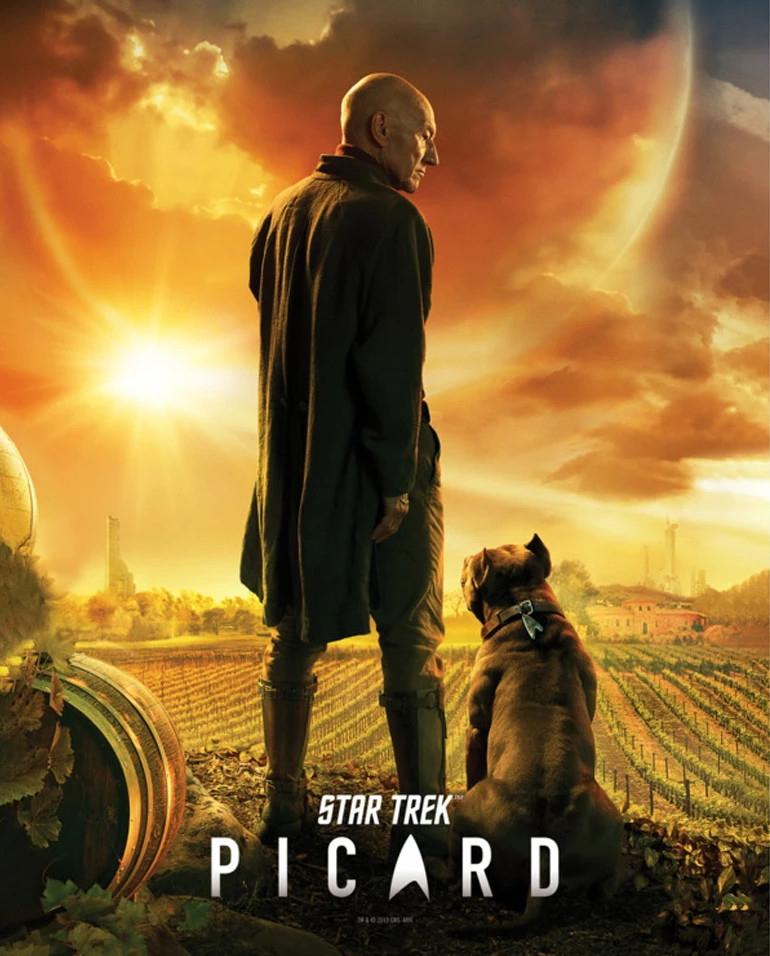
Star Trek Picard follows in the same path set forth by Discovery. With Patrick Stewart in the leading role, I was hopeful. I was hopeful that Star Trek would head back in the direction from which it came. Back to the bright and hopeful vision of the future. Instead it went in the opposite direction.
I have always viewed Captain Jean-Luc Picard as a good character. In this most recent watch through, the first since I have been an adult, I was able to see each of the crews, captains, and shows, in an entirely new light. In the past I saw Star Trek through the lens of a teenager, or very young adult. Is biased me towards episodes where Stuff Is Happening. And my definition of stuff did not include moral conundrums and character growth as Stuff. And while I still thoroughly enjoyed fun romps like Rascals, or adventures such as The Best of Both Worlds, now I have fallen in love with episodes that are more than just action & fun, such as the magnificent The Inner Light. I have come to a have a whole new appreciation of Captain Jean-Luc Picard I can now see has always been a Great Captain and a Good Man.
This watch through of Star Trek has cemented in my mind that Captain Jean-Luc Picard is the paragon of what makes Star Trek what Star Trek is. He is wise and intelligent. He's accomplished and willing to take risks. He is clever and brave. If he can solve a problem with words he will do so. He can solve problems that should be intractable, and do it in a way that brings peace. Yet he was never some mythic figure who could waive his hand and solve any problem. He was just a man like you and I. Older, yes. Wiser, yes. But a man who was an inspiration. Captain Jean-Luc Picard is a man that you can look up to, and emulate.
And the same is true of his entire crew. From his suave first officer, Commander Riker, all the way down to the brash young Wesley Crusher (who demonstrated for us that no matter the personal cost to your self, that you need to tell the truth). Even the Klingon,Lieutenant Worf, had a soft and gentle side to him. This was a crew that was loyal and brave and righteous. And it reflected who Starfleet was, which in turn reflected what Star Trek was.
Star Trek was a shining beacon on a hill. I'm more than happy to nitpick flaws in any episode of Star Trek. From pseudoscience mumbo-jumbo, to reversing the polarity to solve nearly any problem, to noting incredible inconsistencies in the shield power of a ship depending on plot requirements, to the seeming multiple personality disorder displayed by captain Kathryn Janeway, to the unmistakable musk of cheesiness that wafted across the show on an routine basis.
But ever, and always, Star Trek has been an aspirational future. A future where not only are the peoples of Earth at peace with one another, but where they are at peace with the strange and alien cultures that surround them. Not afraid to pick up the sword for war if they must, the people in Star Trek strive with every fiber of their beings for peace and unity.
It this aspirational future which has set Star Trek apart from so much of the other science fiction being created in the world today, and for the past 54 years. It always aimed "further up and further in." It was always pointing the way towards a brighter and better future.
But now we come to Star Trek Picard. I have just completed the fifth of ten episodes in the first season of Star Trek Picard. Unlike it's sister show, Star Trek Discovery, Picard is actually decent science fiction ... as a entirely standalone series, unrelated to a greater mythos. It is an interesting show.
But Picard starts at a place that is so dark that brings our intrepid captain Picard to rageful, impotant, tears. And it strays deeper into darkness with every episode.
With "classic" Trek firmly planted in my mind today, we started the day -my wife and I- with breakfast and the penultimate episode of Star Trek Voyager ("Renaissance Man"). In this episode the doctor puts the entire ship in danger to save the captain. I yelled at the screen a lot, saying that the doctor wouldn't be so foolish as to risk so much for so little. But always when I yelled it was that the character wasn't being smart enough, that he wasn't coming up with a better solution to solve the problem. That he must've been compromised mentally to be so naïve as to believe the bad guys in the episode.
But of course, in the end, the crew won. In fact, one of the captain's captors turned against his allies at the last minute, helping to save the day. It was a story that could easily be seen as a redemption of the bad guy, who changed his ways when right opportunity came along. It featured one of two villains who was unwilling to kill innocent people. A villain who had morals.
But in Star Trek Picard, it seems as though even the main cast doesn't have their morals anymore. It is a grim and dark vision of the future. Where Voyager concluded, even holograms were well on their way to gaining all the rights of people. But where Picard picks up the story, all forms of synthetic life has been banned throughout the Federation, as a knee-jerk reaction to a single event a decade before the show commences.
We see a galaxy full of strife, torn apart by a supernova that somehow managed to destroy the Romulan homeworld. We see the Romulan people turn from a proud and capable race, to violent vagrants scattered far from their homes. But it is not the chaos and darkness outside the Federation it makes the show so difficult to watch. There have always been Barbarians At The Gate; from the Klingons in the original series, to the Kazon of Voyager, there are always people ready to use casual violence and superior might to further their goals.
But in Star Trek Picard we see the very Federation filled with corruption and violence. Riddled with outside agents working for their own nefarious purposes seem as common as loyal members. We see a Federation that for no apparent reason spent the last decade and more with his back turned to the plights of those around it. We see a repressive regime that allows chaos and darkness to fester.
But worse than all of this -we have seen plenty of corrupt Starfleet admirals in the past- is the broken man that is Jean-Luc Picard. A man who has apparently spent the past 10 years wallowing in self-pity after a single conversation did not go his way. We see a man who gave up. He didn't suffer a defeat, and fall back to a new position, as we have always seen him do before. But at the first sign of opposition he apparently crumbled. He abandoned everything he was working towards and literally retreated to his own private chateau, far from danger and harm. We find a man racked with guilt, but too cowardly to do anything about it.
In Star Trek Nemesis there is an exceptional line of dialogue. Picard, as a captive, is being led to his execution. He spends the entire walk talking to his captor. Talking about how it's not too late. It's not too late to change the course of your life. It's not too late to stand up and do the right thing. His captor turns to him and says, "this is how you plead for your life?" And in the absolute essence of Captain Picard, he responds "I am not pleading for my life. I am pleading for yours."
This same Captain Picard, in this new series, gave up on millions of people left them to rot and to die.
This is not the same man who the captained the USS Enterprise.
Star Trek Voyager ended with a joyful and triumphant return to Earth; her crew, and those whom they picked up along their journey, full of bright hope for the future. But Star Trek Picard opens with grim darkness.
Where Star Trek Voyager rescued 7 of 9, and put the entire ship at risk to rescue Echeb, and a few other children from the Borg, Star Trek Picard shows us the now grown and successful Echeb in an episode only long enough to watch him be brutally tortured and killed in scene more at place at the Red Wedding then a Star Trek series. It shows us that Seven has broken, and lost all hope for the future. A bitter shell of a woman driven by revenge (and not in the lighthearted manner of Inigo Montoya). They took a character such as Echeb (whom I saw earlier the same day, young and full of vibrant hope, full of possibilities for the future) and casually killed him in a throwaway scene as a way to motivate a one-time guest character. To take such a character and to literally rip his eye out and cut it off just to show us That we're watching bad guys, in order to sacrifice him upon the altar of lazy plot writing is, I think, the perfect example of what makes this show different than Star Trek of times past.
This new Star Trek revels in taking place in a brutal, dark, and violent galaxy. The Federation is corrupt. Even that paragon of virtue, Captain Jean-Luc Picard, has been sacrificed to give us a gritty and grim show. If I wanted grimm darkness I would go consume Warhammer 40K, or Battlestar Galactica, or even The Expanse. But when I sit down to watch Star Trek, I want to leave the episode with hope for the future, and on a good episode, a moral conundrum to chew over with my wife.
I don't want to leave Star Trek feeling like I've been gut-punched.
So, despite my original cautious optimism about the series, it looks like Star Trek is stretching ever further from delivering Star Trek to my door. If I want a bright and hopeful vision of the future, where cooperation and trust are the rule of the day, it appears that The Orville is, and shall continue to be, the best Star Trek being produced today. I never could have imagined a world where Seth MacFarlane would ever be a better steward of the dream of Star Trek than a series called Star Trek, starring Patrick Stewart. But this is, apparently, the world we live in.
- Go to print friendly version of page.
- Modified: (loading.....)
-
Hits.
- Contact Me.
- Some Icons by icons8.com